

For a sophisticated Limited Partner, the governance checklist for private real estate funds is not a compliance attachment to review after the investment committee approves an allocation. It is the operating architecture that determines who controls capital, how conflicts are contained, when decisions can be challenged, and whether reported performance can be traced to underlying assets, documents, and cash movements.
In private real estate, governance becomes more consequential when a strategy depends on speed. Special situations, off-market acquisitions, and value-add executions require a General Partner that can move decisively without operating beyond the authority granted by its fund documents. The standard is not bureaucracy. It is disciplined discretion.
Contents
Start With the Legal Authority Chain
A fund’s governance begins with a simple but demanding question: does every material action have a clear legal basis? The limited partnership agreement, operating agreement, private placement materials, subscription documents, side letters, and investment management agreements must work as one coherent authority chain.
LPs should confirm that the documents define the investment mandate with enough precision to prevent strategy drift. A mandate described only as “real estate opportunities” grants excessive latitude. A stronger framework specifies asset type, geography, leverage parameters, holding period expectations, permitted affiliates, concentration limits, and the circumstances in which the manager may depart from ordinary investment criteria.
This is particularly relevant in residential value-add strategies. A manager may need discretion to acquire distressed or special-situation assets before a broader process identifies the opportunity. Yet discretion should not become ambiguity. The fund documents should establish the acquisition authority, approval thresholds, and exceptions process before capital is committed.
Confirm the Decision Rights That Matter
Not every decision belongs before an LP advisory committee, but material decisions should never depend solely on informal custom. The governance framework should identify which matters remain with the GP and which require consent, notice, or advisory committee review.
Focus on related-party transactions, changes to investment strategy, amendments to valuation methodology, leverage beyond stated parameters, extension of the fund term, replacement of key persons, and waivers of conflicts. A well-constructed fund may preserve the GP’s operational speed while requiring independent review where economic incentives could diverge.
The practical test is direct: if a decision changes the risk profile, economics, or duration of an LP’s capital, the governing documents should state who has authority and how that authority is exercised.
Establish an Investment Committee With Real Control
An investment committee is only valuable when its role is documented, independent in substance, and supported by an auditable record. A committee that simply ratifies transactions after closing offers presentation value, not institutional protection.
The committee charter should define membership, voting rules, quorum, conflicts disclosures, delegated authority, and documentation standards. It should also state which decisions require committee approval: acquisitions, material rehabilitation budgets, financing, dispositions, refinancing, and significant deviations from the underwriting case.
For a repeatable short-duration strategy, the committee must be calibrated to the pace of execution. Requiring a full committee process for minor field changes can impair asset management. Allowing unlimited discretion for budget changes can erode underwriting discipline. The appropriate line depends on asset concentration, leverage, renovation complexity, and the manager’s demonstrated operating infrastructure.
Committee materials should preserve the original thesis alongside the current facts. That record allows LPs and auditors to distinguish an informed adaptation from an unexplained departure. It also creates accountability when a sponsor elects to sell, hold, recapitalize, or reinvest proceeds.
Make Conflicts Visible Before They Become Problems
Private real estate funds naturally create conflicts. The question is not whether conflicts exist, but whether they are identified early, disclosed plainly, and governed by a predetermined process.
A governance checklist for private real estate funds should require disclosure and approval procedures for affiliated property managers, construction companies, lenders, brokers, co-investment vehicles, warehousing arrangements, and successor funds. Fees paid to an affiliate may be appropriate when they are disclosed, benchmarked, and aligned with the fund documents. They become problematic when the GP can set pricing, allocate opportunities, and approve its own compensation without independent scrutiny.
LPs should examine allocation policies with particular care. When a sponsor manages multiple vehicles, it needs a written process for allocating off-market deals, follow-on capital, debt capacity, and exit opportunities. The policy should address situations in which two funds could reasonably pursue the same asset or when an existing asset may be transferred to another affiliated vehicle.
Disclosure alone is not always enough. For significant conflicts, the stronger practice is advisory committee review, independent valuation support, or a formal fairness process. The right measure depends on the transaction, but the mechanism should be established before the conflict appears.

Apply This Governance Checklist for Private Real Estate Funds to a Live Opportunity
Speak with ARCSA Capital about how our fund documents, investment committee protocol, and LP reporting standards address each control point described here.
Request InformationDemand Valuation Discipline and Cash Transparency
Real estate valuations can be reasonable and still differ materially depending on assumptions about cap rates, renovation completion, market liquidity, buyer demand, and projected exit timing. Governance does not eliminate judgment. It makes judgment visible.
The fund should maintain a documented valuation policy that defines frequency, methodology, approval authority, treatment of unrealized gains, and triggers for third-party appraisal or broker opinion support. For assets undergoing rehabilitation, reporting should separate acquired basis, capital improvements, carrying value, and realized proceeds. Combining these figures can obscure the actual source of return.
Cash controls deserve the same attention. LP reporting should reconcile capital calls, asset-level expenditures, debt proceeds, distributions, reserves, fees, and realized gains. A fund administrator, independent accounting function, or dual-approval payment process can reduce the risk that operational urgency bypasses financial control.
For cross-border investors, transparency should also extend to entity-level cash flows, withholding, tax reporting responsibilities, and the interaction between domestic and offshore parallel structures. Tax efficiency is valuable only when the legal and reporting obligations are equally clear.
Test the Manager’s Compliance Operating System
A private fund’s compliance posture is revealed in its routines, not in a policy manual. LPs should assess how the manager maintains records, handles investor onboarding, monitors sanctions and anti-money laundering requirements, protects nonpublic information, supervises marketing communications, and responds to potential regulatory inquiries.
The relevant requirements will vary by fund structure, investor domicile, exemption relied upon, and advisory activities. A U.S.-focused real estate manager serving international capital must be especially precise about investor eligibility, beneficial ownership records, tax documentation, data security, and cross-border communications.
Ask whether compliance reporting reaches senior management and whether exceptions are logged, reviewed, and remediated. A mature organization can explain not only its policies, but also the controls that prove those policies are being followed.
Review Fees, Expenses, and Waterfall Mechanics Line by Line
Economic alignment is a governance issue. The management fee, acquisition fee, disposition fee, financing fee, property-level affiliate fees, organizational expenses, broken-deal costs, and carried interest must be defined with precision.
The governing documents should state which expenses the fund bears and which remain the responsibility of the manager. Vague language around “customary expenses” is rarely satisfactory for institutional capital. It creates uncertainty precisely where conflicts are most likely to arise.
Waterfall mechanics deserve independent verification before subscription, not after the first distribution. LPs should understand the calculation of preferred returns, catch-ups, carried interest, return of capital, clawbacks, and recycling provisions. If the strategy targets rapid monetization and repeated capital deployment, the recycling provision is especially important: it may increase capital efficiency, but it can also extend the period during which LP capital remains exposed.
Require Reporting That Supports Oversight, Not Marketing
Institutional reporting should allow an LP to assess performance, risk, and execution against plan without relying on narrative alone. Quarterly reports should present fund-level and asset-level metrics, including deployed capital, remaining commitments, realized and unrealized value, leverage, renovation progress, budget variances, concentration, liquidity, and material legal or operational developments.
The strongest reports explain variance. If an exit moved from a three-month expectation to a longer timeline, the report should identify why, quantify the impact, and describe the decision path. If leverage changed, investors should see the covenant profile, maturity schedule, interest-rate exposure, and refinancing plan.
A concise dashboard is useful, but it should be supported by underlying schedules available to authorized LPs, auditors, and fiduciaries. Visibility is not a substitute for control. It is the evidence that control exists.
Build a Governance Calendar, Not a Static Checklist
Governance fails when it becomes an annual exercise. The fund should operate on a calendar that schedules investment committee meetings, valuation reviews, compliance testing, financial close procedures, tax reporting, LP communications, advisory committee sessions, and annual audits.
Each event should have a named owner, required materials, approval record, and escalation path. This converts governance from a collection of legal concepts into a living control environment. It also ensures that operational pressure does not displace fiduciary discipline when a time-sensitive transaction emerges.
For capital allocating to Florida residential opportunities through an institutional private equity structure, this cadence is part of the investment thesis. Arcsa Capital views governance as the mechanism that protects the distinction between access and indiscriminate exposure.
A final standard is worth retaining: a fund’s governance should be clear enough to withstand a difficult asset, a delayed exit, a conflict of interest, and a skeptical auditor. If it only works when every transaction performs as planned, it is not governance. It is optimism.
Governance Checklist for Private Real Estate Funds: 9 Control Points at a Glance
Before an allocation reaches final approval, an LP should be able to answer nine questions without consulting the sponsor. The condensed governance checklist for private real estate funds below is the same sequence institutional diligence teams use when they compress a full review into a single working session.
- Legal authority chain. Every material action traces to a specific clause in the partnership agreement or operating agreement.
- Investment committee. Independent membership, defined quorum, and written approval thresholds for acquisitions, financing, and dispositions.
- Conflict disclosure. Affiliate transactions, related-party service providers, and co-investment allocation policies are documented before they occur.
- Valuation policy. A stated methodology, an independent review cadence, and a record of every override.
- Cash controls. Segregated accounts, dual authorization, and traceability from bank statement to capital account.
- Compliance operating system. Named officers, documented procedures, and evidence the procedures were actually executed.
- Fees and waterfall. A line-by-line reconciliation of management fees, expense allocations, promote calculation, and clawback protection.
- LP reporting. Asset-level reporting that reconciles to audited financials rather than a marketing summary.
- Governance calendar. A recurring schedule of committee meetings, audits, valuations, and LP communications.
A fund that satisfies all nine is not necessarily a better investment. It is a fund whose risks can be measured. That distinction is what a disciplined governance checklist for private real estate funds is designed to produce.
Where LP Protections Actually Live in the Fund Documents
Most investors read the private placement memorandum and stop there. The enforceable protections sit elsewhere: in the limited partnership agreement, the subscription documents, the side letters, and the management agreement. The PPM describes intent. The LPA describes obligation.
Four provisions deserve direct attention. The removal provision defines whether LPs can replace the General Partner and under what vote threshold. The indemnification provision defines how much sponsor misconduct the fund will absorb. The key person provision defines what happens when the individuals who sourced the strategy are no longer involved. The amendment provision defines whether the rules can be changed without LP consent.
U.S. private funds sold to accredited investors operate under exemptions administered by the Securities and Exchange Commission, and the filings, adviser disclosures, and enforcement record published at the SEC are a legitimate second source when a sponsor’s own materials are the only evidence available. Verification outside the data room is part of the discipline.
When these four provisions are read together, the governance checklist for private real estate funds stops being theoretical. It becomes a map of exactly where an LP has leverage and where an LP has none.
Red Flags That Should Pause an Allocation Decision
Governance failures rarely announce themselves. They appear as small procedural exceptions that compound. The following patterns justify a pause rather than a decline, because each one is answerable if the sponsor has the underlying documentation.
- Investment committee minutes that record decisions but not the analysis behind them.
- Valuation marks that move only upward between reporting periods, with no methodology note.
- Affiliate service providers engaged without a written fairness assessment or comparable-cost benchmark.
- Capital account statements that cannot be reconciled to the audited financial statements.
- Side letters granting economic terms that are not disclosed to the full LP base.
- A promote calculated on gross proceeds rather than on returns net of fees and expenses.
None of these is automatically disqualifying. Each one, however, changes the burden of proof. An experienced allocator applies the governance checklist for private real estate funds precisely to decide which questions must be answered before capital moves.
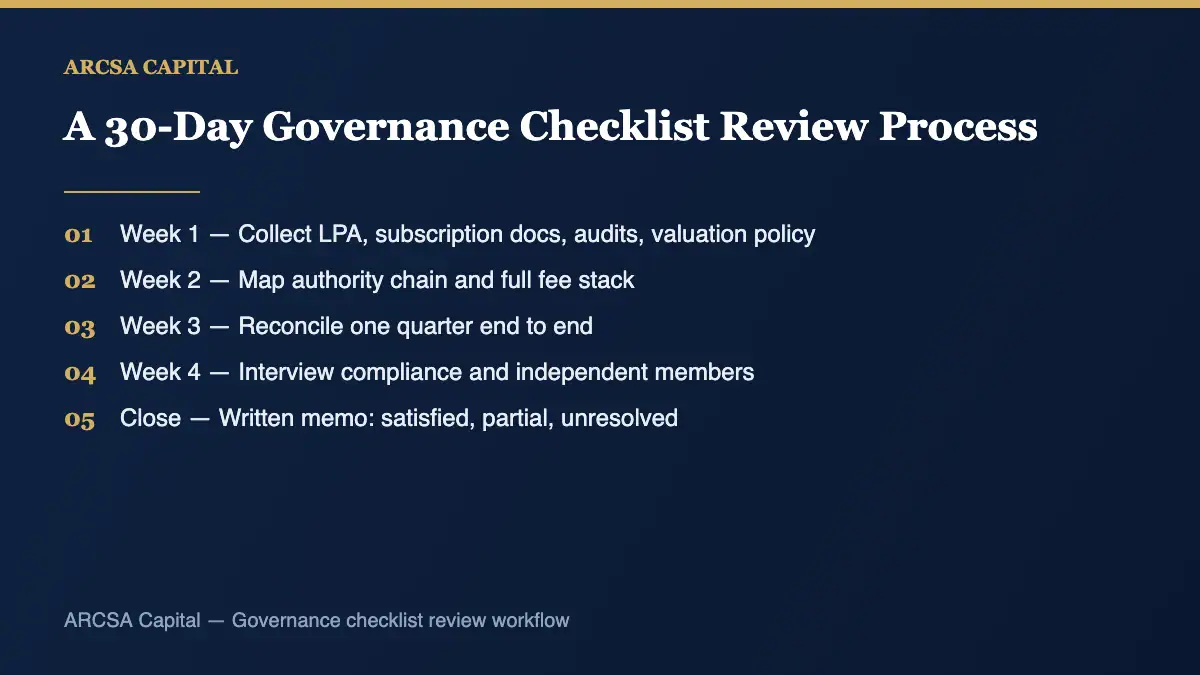
How to Apply This Governance Checklist for Private Real Estate Funds in 30 Days
Week One: Document Collection
Request the LPA, subscription agreement, management agreement, latest audited financials, two consecutive quarterly reports, the valuation policy, and the compliance manual. A sponsor that cannot produce this set within five business days has already answered a governance question.
Week Two: Structural Review
Map the authority chain and the fee stack. Build a one-page diagram showing who approves what, who is paid by whom, and where affiliate relationships sit. Ambiguity in the diagram is ambiguity in the fund.
Week Three: Verification
Reconcile one full quarter end to end: bank statements to capital accounts to reported performance. Confirm adviser registrations and disciplinary history through public regulatory sources rather than sponsor summaries.
Week Four: Interview and Decision
Interview the compliance officer and at least one independent committee member separately from the investor relations team. Close the file with a written memorandum that states which of the nine control points are satisfied, which are partially satisfied, and which are unresolved.
Frequently Asked Questions About Private Fund Governance
How long should a governance review take?
A structured review takes roughly four weeks for a first-time sponsor relationship and one to two weeks for a re-up with an existing manager. Compressing it below that usually means substituting the sponsor’s representations for independent verification.
Does strong governance reduce returns?
Well-designed governance constrains discretion at the points where discretion destroys value: valuation, related-party transactions, and fee calculation. It does not constrain speed of execution when approval thresholds are calibrated to the strategy.
What is the single most important item on the checklist?
Traceability. If reported performance can be traced to documents, bank movements, and asset-level records, most other governance weaknesses become visible and correctable. Without traceability, every other item on the governance checklist for private real estate funds rests on trust alone.
Key Takeaways From This Governance Checklist
- A governance checklist is a decision tool, not a compliance formality: it tells an LP where leverage exists.
- Authority, conflicts, valuation, cash, fees and reporting are the six domains every governance checklist must cover.
- Traceability is the single test that makes the rest of the governance checklist enforceable.
- Apply the governance checklist before the allocation decision, then re-apply it annually as a monitoring routine.
Used consistently, this governance checklist becomes institutional memory. Each fund reviewed with the same governance checklist produces comparable evidence, and comparable evidence is what allows an investment committee to distinguish between a manager with strong governance and a manager with strong marketing.
Request the ARCSA Governance Checklist for Private Real Estate Funds
Qualified investors can review our governance architecture, waterfall mechanics, and reporting package before committing capital.
Request InformationOr model your own scenario in the investment simulator
Or receive the ARCSA Capital investment thesis by email, with the entry, stabilisation and exit assumptions behind the strategy:
